
Call us now :08071792069
 Send Inquiry
 Send Inquiry
Mechanical Protection IK Rating Test
Price 25000 INR/ Piece
MOQ : 1 Piece
Mechanical Protection IK Rating Test Specification
- Applicable Standard
- IEC 62262 / EN 62262
- Purpose
- To determine the degree of protection provided by enclosures for electrical equipment against external mechanical impacts
- Rating Levels
- IK00 to IK10
- Test Name
- Mechanical Protection IK Rating Test
- Customizable Test Setup
- Available upon client requirement
- Test Points
- Defined as per test standard
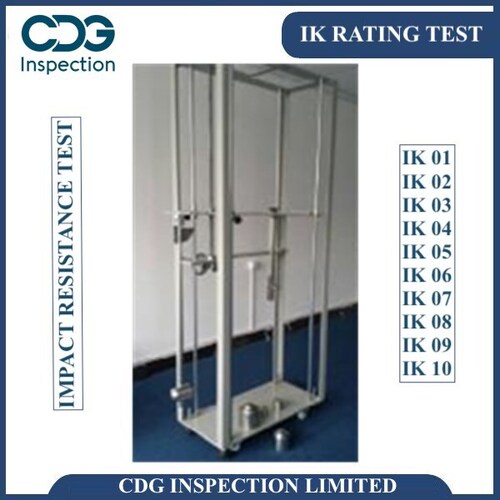
- Test Apparatus
- Spring hammer, pendulum hammer or dropping weight tester as per standard requirements
- Number of Impacts
- 5 impacts per test point
- Test Report Includes
- Photographic evidence, impact data, and compliance statement
- Test Procedure
- Striking the specimen at defined energy levels according to rating
- Impact Location
- Critical weak points or as specified by standard
- Industry Applications
- Electrical enclosures, distribution boards, control panels, lighting fixtures and more
- Inspection
- Visual examination for damage, functional test if required
- Ambient Temperature Range
- -10C to 40C
- Result Assessment
- Conformance to damage and functionality criteria as per test requirements
- Energy Levels
- IK06 1 joule, IK07 2 joules, IK08 5 joules, IK09 10 joules, IK10 20 joules
- Lead Time
- Typically 3-5 working days per test batch
Mechanical Protection IK Rating Test Trade Information
- Minimum Order Quantity
- 1 Piece
- Main Domestic Market
- All India
About Mechanical Protection IK Rating Test
CDG provides mechanical impact protection IK rating test in India.
What is an IK Protection Rating?
IK ratings are defined as IK and a number from 00 to 10, this indicates the degree of protection provided by the electrical enclosures against external mechanical impacts.
IK Ratings (or impact protection ratings) are now the international standard for an enclosure around electrical equipment, IK Ratings were originally outlined in 1995 by the European standard BS EN 50102 and was later amended in 1997 with IEC 60068 2 75. This was then followed up in 2002 with the European standard EN62262 which is the equivalent of the international standard IEC 62262 (2002).
Before the standard use of IK ratings, a third numeral had been occasionally added to the ingress protection rating (IP rating) for example IP66(9), this nonstandard use was one of the main factors that lead to developing a standard. This standard came into effect within 1995 and any conflicting standards had to be withdrawn in 1997.
An IK Rating depicts the way the enclosures should be mounted for the tests to be carried out, even atmospheric conditions, how many impacts should be made (which is based on size of enclosure) and even distribution of the impacts, the size, style, dimensions and even material of the various types of hammer (object) designed to produce the energy levels required. This is then measured in joules.
What are the different IK Ratings?
IK00 There is no Protection.
IK01 Protected against 0.14 joules of impact (this is the equivalent to the impact of a 0.25kg mass dropped from 56mm above)
IK02 Protected against 0.2 joules of impact (this is the equivalent to the impact of a 0.25kg mass dropped from 80mm above)
IK03 Protected against 0.35 joules of impact (this is the equivalent to the impact of a 0.2kg mass dropped from 140mm above)
IK04 Protected against 0.5 joules of impact (the equivalent to the impact of a 0.25kg mass dropped from 200mm above the impacted surface)
IK05 Protected against 0.7 joules of impact (the equivalent to the impact of a 0.25kg mass dropped from 280mm above the impacted surface)
IK06 Protected against 1 joules of impact (the equivalent to the impact of a 0.25kg mass dropped from 400mm above the impacted surface)
IK07 Protected against 2 joules of impact (the equivalent to the impact of a 0.5kg mass dropped from 400mm above the impacted surface)
IK08 Protected against 5 joules of impact (the equivalent to the impact of a 1.7kg mass dropped from 300mm above the impacted surface)
IK09 Protected against 10 joules of impact (the equivalent to the impact of a 5kg mass dropped from 200mm above the impacted surface)
IK10 Protected against 20 joules of impact (the equivalent to the impact of a 5kg mass dropped from 400mm above the impacted surface)
Product details
| Location | India |
| Product Type | Impact Testing Machine |
| Analysis Type | Resistance Analysis |
Comprehensive Protection Assessment
This test evaluates the robustness of electrical enclosures by simulating real-world mechanical impacts. By adhering to global standards, such as IEC 62262 / EN 62262, manufacturers gain assurance that their products deliver reliable protection in demanding applications including electrical, lighting, and control panel installations.
Customizable Testing Solutions
We offer tailor-made test setups to address specific client requirements. Whether validating unique enclosure designs or complying with industry-specific standards, our flexible approach ensures you receive relevant and precise test results suited to your product's intended use.
Detailed and Transparent Reporting
After testing, clients receive a thorough report documenting photographic evidence, impact data, and a clear compliance statement. This transparency facilitates an informed assessment of product quality and ease of certification, promoting confidence among clients and regulatory bodies alike.
FAQ's of Mechanical Protection IK Rating Test:
Q: How is the Mechanical Protection IK Rating Test conducted?
A: The test involves striking enclosures at specified points with calibrated test apparatus such as a spring hammer, pendulum hammer, or dropping weight tester, applying energy levels from 1 to 20 joules depending on the desired IK rating. After each strike, the equipment is visually examined and functionally tested, if necessary, to assess damage and conformance.Q: What types of products are commonly tested under this service?
A: Products such as electrical enclosures, distribution boards, control panels, and lighting fixtures are frequently tested. The test is suitable for any equipment enclosure requiring demonstrated resistance to mechanical impact as per IEC 62262 / EN 62262.Q: Where are the impacts applied during the IK test?
A: Impacts are delivered to critical weak points or other locations specified by the relevant standard. Test points are defined to capture the enclosure's most vulnerable areas, ensuring realistic and meaningful assessment.Q: When can I expect to receive the test report?
A: The typical lead time for a test batch is 3-5 working days. After testing, you will receive a report with photographic documentation, impact data, and a compliance statement.Q: What is included in the Mechanical Protection IK Rating Test report?
A: The report comprises photographic evidence of test setup and results, detailed impact data for each location and energy level tested, and a compliance statement indicating if your product meets the required standard criteria.Q: Can the test setup be customized to fit my product's unique design?
A: Yes, we offer customizable test setups to address specific client needs, ensuring results are relevant to your enclosure's design and intended application. Please share your requirements prior to testing.Q: What are the main benefits of conducting the IK Rating Test?
A: The test ensures your enclosures are robust against mechanical impacts, supports regulatory compliance, and enhances market trust in your products. Thorough documentation also aids certification processes and demonstrates product quality to end-users.
Tell us about your requirement

Price:
Quantity
Select Unit
- 50
- 100
- 200
- 250
- 500
- 1000+
Additional detail
Mobile number
Email

More Products in Impact Protection Rating Category
Impact Protection (IK) Rating Test in India
Price 25000 INR / Piece
Minimum Order Quantity : 1 Piece

 Send Inquiry
Our Products
- Quality Inspection
- Compliance Audit
- BIFMA Testing
- Registration/CoC
- Fire Safety Audit
- Electrical Safety Audit
- Pre-Shipment Inspection
- Third Party Inspection
- C-TPAT Audit
- Ingress Protection (IP) Testing
- Food Grain Inspection
- Oil & Fats Inspection
- Raw & Refined Sugar Inspection
- Animal Feed Inspection
- Factory Compliance Audit
- Industrial Safety Audit
- Green Audit Services
- Garment Inspection Services
- Container Loading Supervision
- Workplace Safety Audit
- ISO 17712 Testing & Certification
- Social Compliance Audit
- Fire Door Inspection
- Mechanical Security Seal Inspection & Testing
- Impact Protection Rating
- Electrical Testing Services

Plot No.- 37, IMT Manesar, Gurugram - 122051, Haryana, India

Mr. A. K. B
(a)
Mobile :08071792069
 Send Inquiry
 Send SMS
Developed and Managed by Infocom Network Private Limited.


